A lot of swim & dive uniform orders go wrong for a reason that has nothing to do with color or budget: the suit a swimmer already owns from club season isn't automatically legal for a high school meet. NFHS's swimming uniform rule is more specific about suit construction than almost any other sport's rule — and the gap between "fast and USA Swimming-approved" and "legal for a CIF meet" catches boosters and coaches off guard every season. Here's what California athletic directors and coaches need to know before ordering.
The suit rule that surprises first-time buyers
NFHS Rule 3-3, Article 2 sets the baseline coverage every competitor's suit has to meet: suits must be one piece, cover the buttocks, and not extend below the top of the kneecap. Boys' suits can't extend above the waist; girls' suits can't extend beyond the shoulders or cover the neck. That part is straightforward and close to what most programs already assume.
The part that trips people up is Article 4, which applies specifically to swimmers (not divers): a competition suit must be constructed of a woven/knit textile material that's fully permeable to air and water, made with no zippers or other fastening system besides a waist tie on a brief or jammer, and built so it can't aid buoyancy or body compression. A lot of high-end racing "tech suits" swimmers wear at club and USA Swimming meets use different, more compressive construction — legal at that level, but not automatically legal under NFHS's rules for a high school meet.
The exception worth knowing: a suit carrying a World Aquatics marking or USA Swimming approval checkmark is still considered legal for NFHS competition if it's otherwise compliant — that marking isn't treated as a second logo or advertising. But "USA Swimming-legal" and "NFHS-legal" aren't the same checklist, so don't assume every suit in a swimmer's club bag clears both.
These are the standing NFHS rules as published for the current cycle; state associations and CIF sections interpret and update them periodically, so confirm the current season's rule book with your section before you finalize a team order — particularly if you're ordering suits with any unusual construction or a suit accommodation for a swimmer with a documented medical need (Rule 3-3 allows state associations to authorize those).
What a swim & dive order actually includes
Swim and dive are usually run as one program with two rosters, and the gear list reflects that:
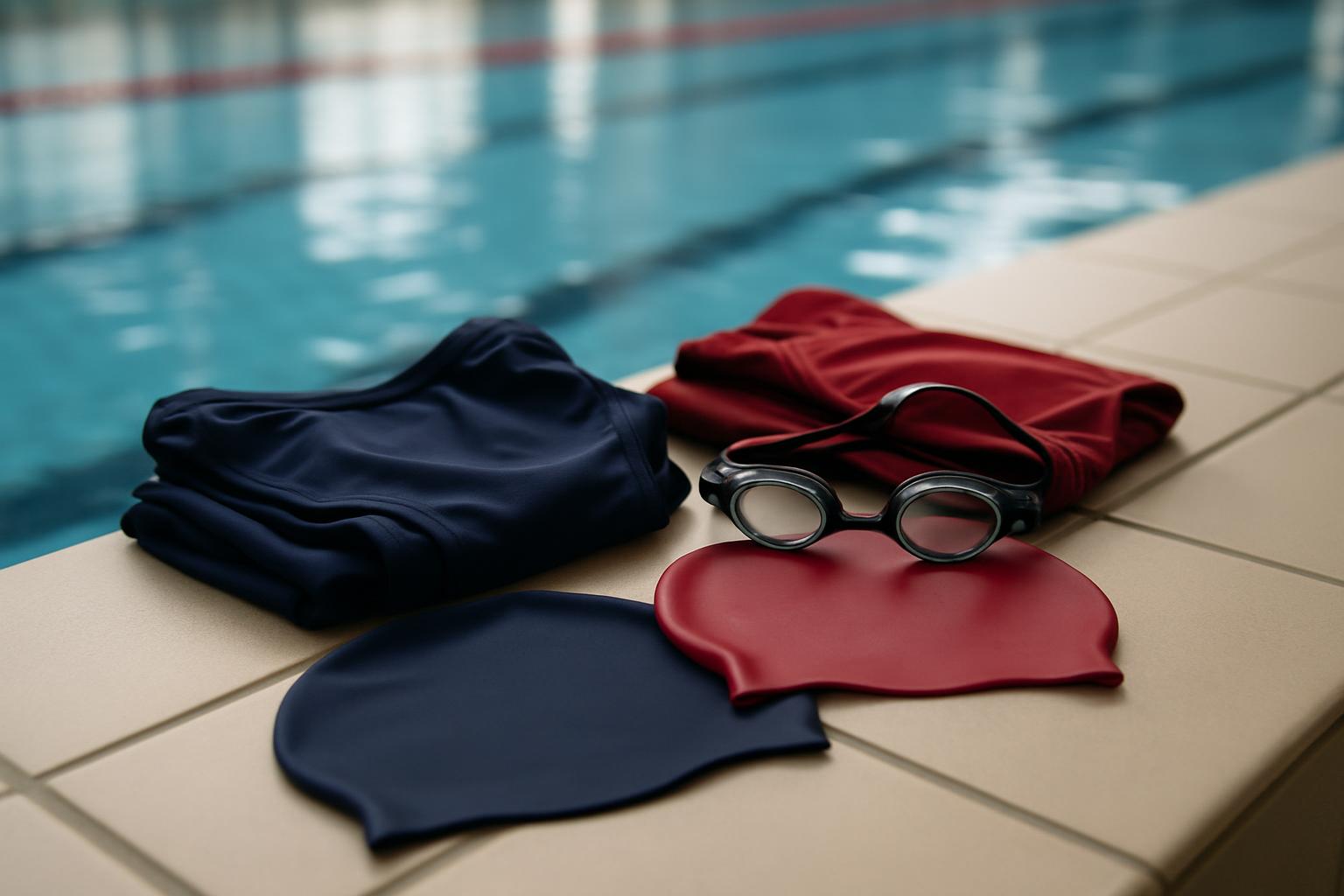
- Team suits — jammers or briefs for boys, one-piece competition cuts for girls, in matching team colors and, ideally, identical pattern (NFHS Rule 3-3 Article 1 recommends — though doesn't require — that the whole team match).
- Caps — an optional but near-universal part of the uniform; caps can carry the school name, logo, or mascot within the same 2¼-square-inch logo limit that applies to suits.
- Warm-ups and parkas — pool decks are cold between events; team parkas are one of the most-used pieces of gear all season.
- Spirit packs — tees, hoodies, and mesh bags for swimmers, divers, and the parents cheering from the bleachers.
Diving has its own equipment beyond the suit — boards, stands, and training aids — that typically comes from a separate equipment supplier rather than a uniform order, so keep that budget line separate when you're planning the season.
Sizing swimmers and divers on one roster
Swim and dive rosters typically run together as one program, but the two groups fit gear differently. A few practices keep sizing from becoming a headache:
- Fit suits snug on purpose — competition suits are meant to fit tighter than everyday swimwear for drag reduction, which reads as "too small" on a generic apparel chart.
- Size divers separately — divers are bound by the same coverage rule but aren't held to the swimmer-specific fabric rules in Article 4, so their suit options and fit can differ from the swim squad's.
- Order spares — competition suits see heavier wear over a season than most uniforms and don't last as many years of reuse.
- Keep caps simple to reorder — caps are the easiest and cheapest piece to replace mid-season if a set gets lost or damaged.
Our team uniform sizing hub has general charts and a measuring guide, and the water polo and swim entries on our equipment checklists cover what belongs in a full aquatics order beyond the suit itself. If your program also runs water polo, note that its suit and cap rules are governed separately — don't assume gear crosses over between the two sports.
Branded or non-branded?
National Sports Apparel's swim & dive catalog carries TYR, Speedo, Arena, Adidas, and FINIS for suits, caps, goggles, and dive training gear, plus New Balance and Adidas for warm-ups and spirit packs. TYR runs the deepest dedicated team program of the group, with team pricing and custom decoration built specifically for high school and club rosters. Quality non-branded suits deliver NFHS-legal construction at a lower per-athlete cost and are common for JV squads or programs stretching a tight budget across a full roster. Because we carry both, we can quote them side by side against your actual roster.
The ordering calendar
Swim & dive runs later in the year than most programs plan for. CIF Southern Section's published 2026-27 calendar bars swim and dive meets before February 21, 2027, with diving competition wrapping by late April and swimming by early May. Working back a typical 6 to 10 week custom production window — plus the seasonal backlog every team dealer sees heading into winter — puts the safe order deadline in November or December, months before most programs start thinking about the pool. Section calendars are updated periodically, so confirm your own section's current dates before you set a deadline.
- November–December: finalize suit design, cap colors, and sizing. This is the window that keeps you ahead of the rush.
- January: production and decoration.
- February: gear in hand before the first contest.
Working with a team dealer
Swim & dive's construction rules trip up dealers who don't outfit the sport regularly — the difference between a legal competition suit and a club tech suit isn't obvious unless you know the rule to check for. National Sports Apparel has outfitted California high school, club, and college aquatics programs since 2009, with no order minimums, so a small club team and a full varsity/JV roster get the same attention.